The Startup Revenue Acceleration Playbook: $0 to $43M in One Year
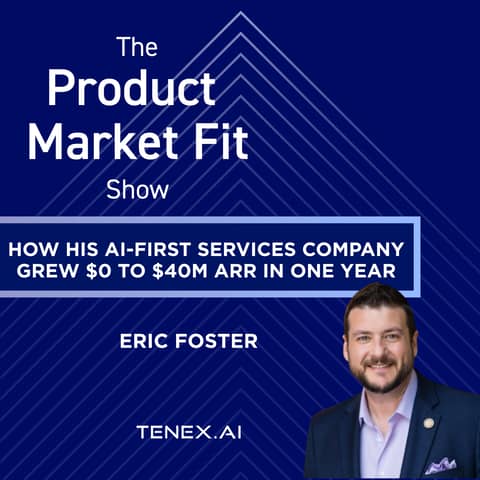
Eric Foster built his first computer in 1989. By the mid-90s, he was fighting cybercriminals over dial-up modems. Thirty years later, he sold his cybersecurity company CYDERES to private equity in a deal that created a billion-dollar merged entity with Shark Tank's Robert Herjavec. That should have been the victory lap. Instead, Foster realized he'd built one of the top five managed detection and response companies — but just created another MSSP, executing better but not fundamentally different. When AI breakthroughs emerged in 2022-2023, Foster saw the platform shift he'd been waiting for. Not the next dot-com boom — the next PC revolution. In 2024, he founded TENEX to rebuild cybersecurity services from first principles using AI. The startup revenue acceleration that followed defies conventional metrics: $43 million projected in year one, Fortune 500 customers signing in 60 days instead of year-long cycles.
Key Takeaways: How TENEX Achieved Record Startup Revenue Acceleration
- TENEX projects $43 million in revenue in its first year from first dollar — unprecedented for cybersecurity
- Hit $10 million in revenue within six months of market launch
- Average contract values: $500K ARR for Global 2000 customers, $100K ARR for mid-market segment
- Raised $27 million Series A from Crosspoint Capital, Andreessen Horowitz, and Shield Capital
- First enterprise customer signed in under 60 days from initial contact — typically a 12-month cycle
- AI-native architecture where one analyst does work that historically required ten people
- Go-to-market split: 40% direct sales, 40% channel partnerships, 20% inbound/marketing
- Previous company (CYDERES) grew from zero to 300 employees and $400-500M valuation in four years
- Platform demonstrates AI completing one hour of analyst work in one second through agentic clusters
- Same-day customer onboarding versus 3-6 month traditional implementation timelines
Table of Contents
The Thirty-Year Overnight Success Why This Time Was Different The Innovator's Dilemma Advantage What AI-Native Actually Means in Practice Selling Outcomes Not Products The Demo That Closes Enterprise Deals From Zero to Fortune 500 in Sixty Days The Pricing Strategy Why Founder-Led Sales Still Matters The GTM Model That Drives Growth Product-Market Fit Recognition
The Thirty-Year Overnight Success
Eric Foster's path to building one of the fastest-growing cybersecurity companies started with hobbyist computers in 1989. By the mid-90s, he was installing networked computers in small businesses and fighting off war-dialing hackers who literally called phone numbers looking for vulnerable modems.
That exposure led naturally to cybersecurity. "Cybersecurity exists because that's where the money was," Foster explains. "The moment you started to put payments online, very quickly thereafter you had cybercriminals."
Foster built and sold his first web services company, then became a Chief Information Security Officer at a publicly traded financial services firm. The path — operator, CISO, consultant, reseller, then startup founder — gave Foster visibility into every angle of the industry. His previous company, CYDERES, became one of the top five managed detection and response providers before being acquired in a deal that merged it with Robert Herjavec's company to create a billion-dollar entity.
The company reached 300 employees in four years. Changed many lives through the exit. But Foster kept returning to the same realization: "We'd built a great company, we'd built one of the top five MDRs, but it wasn't different. It was the same." Better execution within the existing paradigm — not the transformation Foster envisioned.
Why This Time Was Different
The catalyzing insight came from a CFO years earlier who refused Foster's request to build out his security team, insisting he buy a managed service instead. "I basically pushed back and said, you don't understand. There's nobody out here from a managed services perspective that's worth working with. They're all either ridiculously high priced or they're really terrible quality."
That frustration drove CYDERES. But even after building a top-five provider, the fundamental economics hadn't changed enough. Then came the AI breakthroughs of 2022-2023. Foster saw what Jensen Huang calls "accelerated compute" — a shift comparable to the PC revolution.
"We're standing at the precipice not of the next dot-com boom. We're standing at the precipice of the PC revolution," Foster argues. His thought experiment: the neighborhood taco truck. Twenty years ago, why would they have computers? Today, every taco truck uses Google Maps, DoorDash, Facebook, Square payments on an iPhone with more computing power than mainframes Foster started his career on.
"Artificial intelligence is going to do the same thing to the entirety of the workforce," Foster predicts. The company name — TENEX — means "order of magnitude." If one person can do the work of ten through AI, you don't need fewer people. You accomplish exponentially more.
The Innovator's Dilemma Advantage
Foster credits one crucial advantage: he'd already built and sold a company in this space. "Even if I was just my old company with a thousand employees and nice revenue, and I see this platform shift, the right thing to do is destroy everything and start over. Rebuild absolutely everything to take advantage of AI."
Legacy companies can't do that. Payroll. Customers. Existing systems. Tearing it down would pause revenue and potentially destroy the business. "These legacy guys try to bolt this on."
TENEX benefits from no legacy. Clean sheet. First principles. That enabled them to hire world-class software engineers attracted by one factor: shipping code to production. "They literally ship more code here in a quarter than most shipped their entire careers at a hyperscaler."
What AI-Native Actually Means in Practice
In traditional managed security, an analyst gets an alert, pulls it up, tries to understand context, runs searches, and pieces together what's happening. "Maybe fifteen minutes if everything went perfect. More often, an hour or two hours of work."
At TENEX, seven or eight AI agent clusters constantly work in the background. When an alert fires, the AI has already clustered thirty related alerts, produced a summary, assigned the right playbook, and pulled all relevant data. "When you pull it up, the AI in one second has done an hour's worth of human work."
The human remains in the loop — Tesla's self-driving model where humans maintain control but AI handles heavy lifting. Corporate buyers won't hand over security to pure AI, but they'll adopt services that leverage AI to amplify human expertise. This shows up everywhere: finance, contracting, legal, onboarding, customer success, engineering all built AI-native from day one.
Selling Outcomes Not Products
Foster shares a famous marketing example about quarter-inch drill bits. "Nobody buys a quarter-inch drill bit because they want to own it. You buy one because you need a quarter-inch hole. But you don't actually need a hole — you need to hang a shelf. And you don't need a shelf. What you need is how you're going to feel when you organize your bedroom."
That feeling — safety, security, accomplishment — is what you're selling. "That is ultimately what we're selling. We're going to fight evil on your behalf. We're going to make you more secure. We're going to stop the bad guys."
Importantly, TENEX sells what customers already understand and budget for. They're not creating a new category. Today's customers either have in-house security or use a managed provider. TENEX walks in with demonstrable product that's provably better. Customers "get it in an instant."
The Demo That Closes Enterprise Deals
One of TENEX's first customers was a top-five global financial institution. From first contact to signed contract: under 60 days. Enterprise cybersecurity procurements typically take 12+ months.
The CISO had met with all the big vendors promising AI would change everything. "They all go, well, we're building this and seven months from now we're going to have this release."
Foster and his CTO walked in with two laptops. "One was our product, the other was our console showing all the API calls, all the AI queries happening on the backend. This isn't demo ware. All of this is real, all of this works today."
Show them an alert. Traditional systems require an hour of investigation. With TENEX, "the AI has already clustered thirty different alerts. It's already produced a summary of what's going on, assigned the right playbook, pulled all the data sources together."
Light bulbs go off immediately. That's how you compress 12-month cycles into 60 days.
From Zero to Fortune 500 in Sixty Days
TENEX's strategy deliberately targeted upmarket first. "Sell to bigger companies at bigger dollar values and then go down market." Half of the first ten customers were publicly traded Fortune 500 companies with material contracts demanding real security outcomes.
"The average across the Global 2000, they're probably $500K-ish ARR," Foster reveals. The second cluster sits around $100K ARR for mid-market. "Double bell curve."
Why serve both segments? "The whole point of a startup is ultimately to find product market fit. Once you find it, you should throw as much fuel on the fire as you can." If one dollar produces five dollars of business value, deploy as many dollars as possible until returns diminish.
Beyond economics, the mission matters. "My mission isn't just to bring better cybersecurity to the two hundred biggest banks. It's to take solutions we've put in place in the biggest banks and go to this hundred and fifty person credit union." The biggest banks have led cybersecurity for thirty years. Bringing that quality to small organizations at a fraction of the price? That's democratization.
The Pricing Strategy
Building a 24/7 in-house security center requires minimum 15 employees just for coverage. "If you want those people to have any quality of life, you've got to hire fifteen employees just to make a 24/7 team," Foster explains. For mid-sized businesses, that's a non-starter.
A $500K TENEX contract delivers enterprise-grade security — AI-augmented analysts, 24/7 coverage, comprehensive alert analysis — for a fraction of in-house costs. The product is approximately 15-20% more cost-effective than traditional managed services while delivering better outcomes. "I don't have to be TENEX less expensive. If I'm fifteen or twenty percent more cost-effective, that's still a massive win."
The "better" manifests in ways competitors can't match. Traditional providers can't look at every alert — they lack human capacity. "You guys aren't looking at all your alerts today, right? No, of course not, nobody could. Guess what? I am and I can prove it."
Machine-scale analysis of every alert. Not sampling. Not prioritization that misses threats. Comprehensive coverage with provable metrics.
Why Founder-Led Sales Still Matters
Despite building an enterprise-ready company, TENEX leans heavily on founder-led sales. "I'm a huge proponent of founder-led sales. Especially these days where a solopreneur or the tech genius starts the company and they can't sell."
His prescription: if you're the technical founder and can't sell, find a co-founder who can. "You have to have both roles. You have to have somebody who can sell and somebody who can build."
Early adopters buy the founder as much as the product. "They're buying your vision. Your ability to execute. What you're selling into the world that you're going to create."
Foster brings thirty years of relationships. "One of my first customers has been my customer four times. They bought four different products from me at four different companies." That trust accelerates sales, but the product must deliver demonstrably.
The GTM Model That Drives Growth
TENEX's go-to-market splits roughly 40/40/20. About 40% comes from direct enterprise sales. Another 40% flows through channel partnerships. "If you do it right, if you have true channel partners, they can drive huge value."
The remaining 20% comes from inbound and marketing-driven demand. Cybersecurity has a tight-knit community. CISOs talk. Successful deployments create buzz.
Channel partners need solutions they can confidently sell. TENEX's demonstrable superiority and immediate ROI make it easy for the right partners. The 40/40/20 model provides diversification — no single channel dominates.
Product-Market Fit Recognition
"When did you feel like you had true product market fit?"
"When we closed our first deal. Quite honestly, immediate validation. It was a top financial institution, publicly traded, one of the biggest companies."
That first customer — a Fortune 500 financial firm — signed a full contract in under 60 days. Not a pilot. "When it's like your ideal customer and you see that immediate fit where they're like, we're going to throw out all these procurement rules. We got to get this through right now. That's product market fit."
Foster acknowledges his advantage: "The only reason we did that is because we've been doing this so long. We built products in this space before." Thirty years of seeing what doesn't work meant they could nail it from version one.
Frequently Asked Questions
How did TENEX achieve $43 million in first-year revenue?
TENEX combined AI-native architecture that demonstrably works better, founder-led sales leveraging 30 years of relationships, targeting Fortune 500 customers with $500K ACVs from the start, and same-day onboarding that delivers immediate ROI. They compress 12-month enterprise cycles into 60 days by showing working product, not vaporware.
What does AI-native mean for TENEX?
AI-native means every function was built from first principles around AI rather than bolting AI onto existing processes. TENEX's AI can complete one hour of security analyst work in one second by automatically clustering related alerts, generating summaries, assigning playbooks, and pulling relevant data before humans review incidents.
How much cheaper is TENEX than traditional providers?
TENEX is approximately 15-20% more cost-effective while delivering provably better and faster outcomes. The value proposition isn't primarily price — it's superior security (analyzing 100% of alerts vs. sampling), faster response times, and better outcomes at somewhat lower cost.
What is TENEX's average contract value?
TENEX has a double bell curve: Global 2000 companies average $500K ARR, while mid-market customers average $100K ARR. These are annual recurring revenue figures representing real contracted revenue.
Why target Fortune 500 customers first?
Selling upmarket provides higher ACVs accelerating revenue growth, reference customers validate the product for all prospects, and demonstrating capability in demanding environments proves the platform handles any security requirements. TENEX then uses those capabilities to serve mid-market at lower price points.
How does TENEX onboard customers so quickly?
TENEX delivers value the same day customers sign contracts. The AI-native infrastructure handles configuration automatically rather than manual setup requiring months. Immediate ROI is critical for revenue recognition and creating reference customers.
What is founder-led sales?
Founder-led sales means founders personally sell to early customers rather than immediately hiring sales teams. Early adopters buy the founder's vision and credibility as much as the product. Eric Foster's 30-year cybersecurity career gave him instant credibility with Fortune 500 CISOs, enabling rapid cycles.
How did TENEX compress sales cycles from 12 months to 60 days?
TENEX shortened procurement by having working product (not vaporware), demonstrating clear superiority in 30-second demos, targeting known market needs with existing budget allocation, and leveraging founder relationships to navigate procurement. When CISOs see AI doing one hour of work in one second, procurement moves fast.
Listen to the Full Episode
Want to hear more about achieving unprecedented startup revenue acceleration through AI-native services? Listen to the complete Product Market Fit Show episode where Pablo Srugo and Eric Foster dive deep into the thirty-year overnight success story, why this PC-revolution-level platform shift enables $43M first-year revenue, and why selling outcomes beats selling products every time.

Partner | Mistral
Pablo is a Partner at Mistral, a seed-stage firm based in Canada. Before joining Mistral, Pablo was a founder and COO at Gymtrack, a venture-backed start-up in the FitTech space. Prior to Gymtrack, Pablo founded an online tutoring platform targeting university students, which was acquired in 2014.
The Startup Acquisition Strategy That Built a $5B Parking Empire

